

A complete beginner’s guide to making money on odds differences
A beginner’s guide to arbitrage betting
THE BETTING WORLD has grown into something huge. Global gambling revenue passed $643 billion in 2025, and online betting now makes up close to 20% of that activity. With so much money moving around, gaps in the numbers show up all the time. Different bookmakers price the same event differently. And those small price gaps can turn into real profit for people who know what they’re doing.
This guide breaks down how that works. It’s written for newcomers who want a clear, honest look at the method known as arbitrage betting (or “arbing” for short). No fluff. Just the steps, the math, and the warnings.
What Arbitrage Betting Actually Means
Arbitrage betting is the practice of placing bets on every possible outcome of an event, using different bookmakers, so that you lock in a profit no matter what happens. The trick depends on price differences. When one bookmaker thinks a team has a 55% chance and another thinks it has a 50% chance, their odds won’t match. That mismatch is the opening.
It’s sometimes called a “surebet” because the outcome is decided before the game even starts. You aren’t guessing who wins. You’re just collecting the gap between two sets of prices.
But here’s the catch. The profit margins tend to be tiny. Most arbitrage chances sit somewhere between 1% and 5% of your total stake. So the appeal isn’t getting rich on one bet. It’s stacking many small, steady gains over time.

Step 1: Learn How Odds Work
Before anything else, a beginner needs to read odds without hesitation. Three formats dominate the market: decimal, fractional, and American. Decimal odds are the easiest for arbitrage math, so most arbers stick with those.
Each set of odds carries an “implied probability.” That’s the chance the bookmaker assigns to an outcome. You find it with a simple formula:
Implied probability = 1/decimal odds
So odds of 2.00 mean a 50% implied chance. Odds of 4.00 mean 25%. Once you can flip odds into percentages in your head, the rest gets much simpler.
| Decimal Odds | Implied Probability | $100 Bet Returns |
| 1.50 | 66.7% | $150 |
| 2.00 | 50.0% | $200 |
| 3.00 | 33.3% | $300 |
| 4.00 | 25.0% | $400 |
Step 2: Understand the Surebet Formula
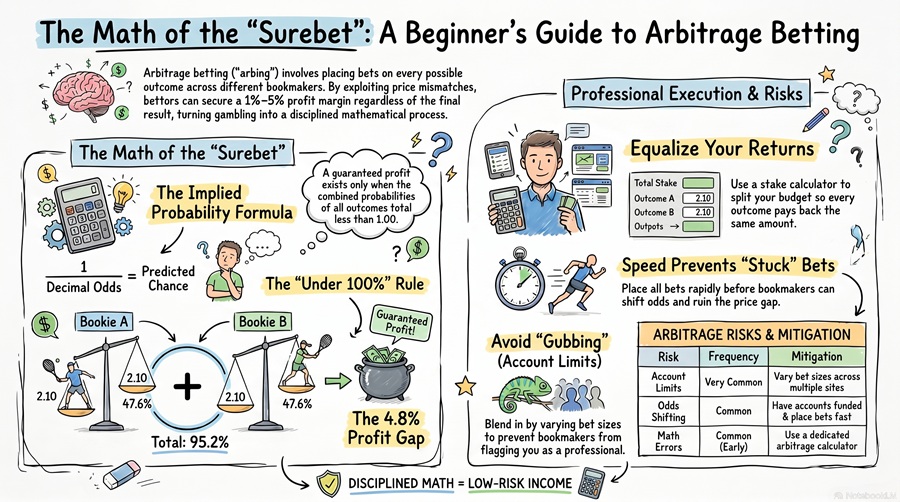
An arbitrage exists when the combined implied probabilities of all outcomes add up to less than 100%. That’s the whole secret. If the total comes in under 1.00, you’ve found a guaranteed profit.
Take a tennis match with two players. One bookmaker offers 2.10 on Player A. Another offers 2.10 on Player B. The math:
(1 / 2.10) + (1 / 2.10) = 0.476 + 0.476 = 0.952
That total of 0.952 is below 1.00. So this is a surebet. The 4.8% gap is your profit margin, before you split your stake correctly across both bets.
Why does this happen at all? Bookmakers disagree. Some react slowly to news. Others shade their prices to attract certain bettors. Those disagreements create the cracks that arbers slip through.
Step 3: Calculate Your Stakes
Finding a surebet is only half the work. You also have to split your money so each outcome pays back the same amount. Otherwise you might profit on one result and lose on another.
The stake for each outcome follows this formula:
Stake = (Total budget x implied probability of that outcome) / total implied probability
Say you have $1,000 to bet on the tennis example above. Each side gets:
($1,000 x 0.476) / 0.952 = $500
So you place $500 on each player. Both sides return $1,050 (your $500 stake at 2.10 odds). That’s a guaranteed $50 profit on $1,000 risked, no matter who wins.
Most people don’t do this math by hand. Free arbitrage calculators handle it in seconds. Still, knowing the logic protects you from blindly trusting a tool.
Step 4: Find the Opportunities
This is where beginners spend most of their early effort. You need to scan many bookmakers fast, because price gaps close quickly. A surebet that exists at 9:00 a.m. might vanish by 9:05.
There are two main paths. You can search manually by comparing odds across sites, which is slow but free. Or you can use an arbitrage scanner that monitors dozens of bookmakers at once and flags gaps automatically. Most serious arbers pay for a scanner. The time saved usually covers the cost.
Football is the most popular market for this. It offers thousands of matches each week, and the odds vary widely between sites. Tennis, basketball, and eSports also tend to produce frequent gaps. If you want to test a low-risk skill game while you build your bankroll, you can to play something simple with clear odds and adjustable risk.
| Market Type | Frequency of Arbs | Difficulty for Beginners |
| Football | Very High | Low |
| Tennis | High | Low |
| Basketball | Medium | Medium |
| eSports | Medium | Medium |
Step 5: Place Bets Quickly and Carefully
Speed matters more than almost anything else here. Once you spot a gap, both bets need to go in fast. If one leg gets placed and the odds shift before the second, you’re suddenly exposed to real risk. That’s called being “stuck,” and it’s the main way beginners lose money on a method that’s supposed to be safe.
So keep your accounts funded ahead of time. Have your stakes calculated before you click. And double-check the match details (date, teams, market type) on both sites. A mismatched event ruins the whole setup.
Some arbers report consistent monthly returns in the range of 5% to 15% on their active bankroll. Others see less, depending on time invested and market access. Real-money testimonials from players, like those covered in this player success feature, show that steady gains are possible, though results vary a lot from person to person.
Step 6: Track Everything
Data is your proof of progress. Every bet you place should go into a spreadsheet or tracking app. Record the date, the bookmakers, the odds, your stakes, and the result. Why bother? Because patterns emerge. You’ll spot which sites limit you, which markets pay best, and whether your real profit matches your expected profit.
A simple log might track these columns: event, date, bookmaker A odds, bookmaker B odds, total stake, expected profit, and actual profit. Over a few hundred bets, that record becomes the clearest picture of how well your method is working.

The Real Risks Beginners Ignore
Arbitrage is often sold as “risk-free.” It mostly is, in math terms. But the practical risks are real, and they bite hard.
Bookmakers hate arbers. When a site notices you only bet on price gaps, it may limit your stakes or close your account entirely. This is the single biggest threat to long-term arbing. Many pros spread bets across many accounts and avoid obvious patterns to stay under the radar.
Other risks include canceled bets (the bookmaker voids one leg), human error in stake math, and odds that drop mid-process. None of these are rare. Probably the smartest move for a beginner is to start small, accept a few mistakes, and treat the first month as paid training.
| Risk | How Common | How to Reduce It |
| Account limits | Very common | Vary bet sizes, use multiple sites |
| Voided bets | Occasional | Read each site’s rules first |
| Odds shifting | Common | Place both bets fast |
| Math errors | Common early on | Use a calculator, double-check |
Is This Method Right for You?
Arbitrage betting rewards patience, organization, and quick fingers. It isn’t a get-rich-quick scheme, and anyone selling it that way is lying. The gains are small per bet and demand real effort to find. But for people who treat it like a part-time job rather than a casino night, the steady math has held up across the growing online betting market, which itself jumped from $106 billion to roughly $117 billion between 2024 and 2025.
Start with paper trades. Build a small bankroll. Keep clean records. The people who succeed at this aren’t gamblers chasing a thrill. They’re more like bookkeepers who happen to bet.