
Best neighbourhoods for first-time buyers in Toronto (2026)
Executive Summary: Choosing the Right Toronto Neighbourhood
A NEIGHBOURHOOD DECISION should begin with the mortgage ceiling, not a list of fashionable postal codes. This guide explains how to compare recent local sales, ownership costs, transit reliability, school boundaries and building or street-level risks before touring. It also shows why the lowest asking price may not represent the strongest value. For first-time home buyers Toronto neighbourhoods become easier to compare when every option is measured against clear deal-breakers and a realistic five-year plan.
What Can First-Time Home Buyers Afford in Toronto in 2026?
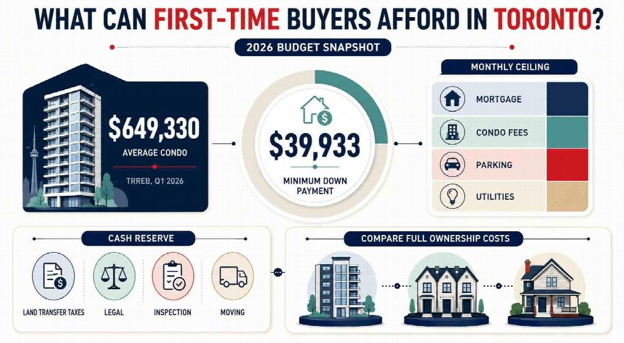
For first-time home buyers Toronto affordability should be measured by a lender-approved monthly ceiling, not the highest price in a pre-approval. TRREB reported that City of Toronto condo apartments averaged $649,330 in Q1 2026. At that price, the minimum down payment is about $39,933, while putting down less than 20% normally requires mortgage insurance.
Buyers must also reserve cash for two land transfer taxes, legal work, inspection or appraisal fees and moving costs. A cheaper condo may still cost more monthly when fees, parking and utilities are included. Comparing complete ownership costs shows whether a condo, townhouse or older house genuinely fits the budget.
Best Toronto Neighbourhoods for First-Time Buyers by Budget
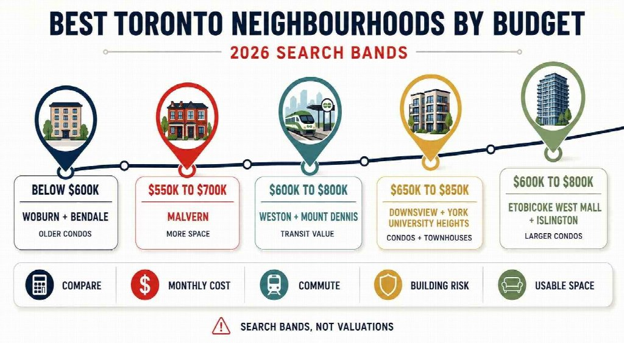
Price bands are more useful than labels such as “affordable.” Searches for starter homes Toronto often surface very different property types, so use the ranges below as working search bands, not valuations. Confirm every shortlist against recent sold prices for the same ownership type, bedroom count and nearby streets.
Woburn and Bendale: Best Below $600,000
Buyers below $600,000 should begin with older condo apartments in Woburn or Bendale. These areas can offer practical layouts and daily services, although maintenance fees and building finances may change the real value.
Malvern: More Space from $550,000 to $700,000
Between $550,000 and $700,000, Malvern may add condo townhouses and larger units to the search. Extra space can suit growing households, but buyers should test bus-dependent commute times before treating size as the deciding advantage.
Weston and Mount Dennis: Transit Value from $600,000 to $800,000
For first-time home buyers Toronto neighbourhoods around Weston and Mount Dennis become relevant near $600,000 to $800,000. GO, UP Express and Eglinton Line access can shorten some trips, but compare door-to-door travel time from the exact address.
Downsview and York University Heights: Options from $650,000
With roughly $650,000 to $850,000, Downsview and York University Heights can provide newer condos or selected townhouses. Check how much of the price reflects walking-distance transit access, then review traffic, construction and future development nearby.
Etobicoke West Mall and Islington: Larger Condos Under $800,000
Budgets around $600,000 to $800,000 may reach larger condos in Etobicoke West Mall or Islington. Older buildings can offer better floor plans, although reserve-fund strength, special assessments and parking costs require careful review.
When comparing Toronto homes for sale, rank each option by monthly cost, commute, building risk and usable space. The best-value neighbourhood is the one that protects your budget while meeting the daily needs you cannot reasonably compromise.
How to Check Toronto Neighbourhood Safety Before Buying?
A search for starter homes Toronto may highlight low prices, but it cannot show how a specific block feels after dark. Build a street-level safety check from several evidence sources, not reputation alone.
- Filter Toronto Police data across three to five years and separate violent crime, theft and break-ins.
- Compare incidents with local population and nearby streets, then review traffic collisions and school routes.
- Visit after dinner and during rush hour. Check lighting and sightlines, transit stops, garage access and pedestrian activity.
For first-time home buyers Toronto safety becomes clearer when data is combined with two real-world visits. Treat unexplained patterns as reasons to investigate, not proof that an area is unsafe.
Condos, Townhouses or Houses: Which Starter Home Fits Your Budget?
For first-time home buyers Toronto property choices should reflect the next five years and each ownership type’s workload. A condo apartment usually offers the lowest entry point and simpler exterior maintenance, but buyers must examine fee inclusions and the status certificate. Condo townhouses add bedrooms and private entries, although fees may cover less.
Freehold townhouses, semis and detached houses remove monthly condo fees but transfer roof, drainage, heating and exterior repairs directly to the owner. Within the starter homes Toronto market, compare usable space per dollar with a five-year repair reserve. The right choice is the home you can maintain without delaying other financial goals.
How to Shortlist a Toronto Neighbourhood Before Buying?
A search for starter homes Toronto should produce three neighbourhoods, not disconnected listings. Set non-negotiable requirements and a maximum monthly cost, then score every area consistently.
- Remove areas where same-type sales exceed your purchase ceiling or provide too little active inventory.
- For first-time home buyers Toronto shortlists improve when each area meets minimum space needs and an acceptable commute.
- Save five comparable properties per area. Track price changes, condo fees, parking and sold prices.
Keep one backup area, but do not expand whenever a listing disappoints. A consistent scoring sheet limits emotional compromises and gives your agent a precise search brief.

How to Find the Right First Home in Toronto?
The right first home is usually the property that remains workable after the showing excitement fades. Before offering, ask your agent to verify recent comparable sales, listing history, expected deposit timing and the seller’s preferred closing date. Keep financing, inspection or status-certificate protections when the risk justifies them. For first-time home buyers Toronto decisions become safer when a written walk-away price is set before negotiations, not during them.
FAQs for First-Time Home Buyers in Toronto
Which first-time buyer rebates are available in Toronto?
For first-time home buyers Toronto purchases may qualify for provincial and municipal land transfer tax rebates, but eligibility must be confirmed. Keep closing cash separate until your lawyer provides the final statement.
Can buyers rely on the school named in a listing?
Never rely solely on listing remarks. Enter the exact property address in the appropriate school board locator and confirm program availability, since attendance boundaries and optional access can change.
Do Toronto buyers need a buyer’s agent?
Review the buyer representation agreement before touring seriously. It should define services, duration, geographic scope, cancellation terms and any commission shortfall you might owe.
What should be checked before making an offer?
A search for starter homes Toronto may identify condos and houses with different risks. Request a status certificate for condos and an inspection or permit review for houses, keeping a workable review period and obtaining independent legal advice.