

Online casino is taking a larger share of Ontario iGaming: How the product mix is shifting in 2026
The Ontario casino game market has far exceeded the most optimistic projections from just a few years ago
WHEN ONTARIO’S iGAMING market opened in April 2022, 18 operators launched 31 websites and collectively generated $162 million in revenue in just their first three months. By the first quarter of 2026, Ontario residents were betting $27.8 billion in a single quarter, and iGaming operators reported revenue of $1.13 billion for those three months. The market ended 2025 with $4 billion in annual revenue, a 34% increase from the previous year and the best year for the market to date. While the market’s exponential growth in the last four years is impressive, what is more interesting is what Ontario residents were betting on.
The answer is casino games. During the initial period of Ontario’s iGaming market, sports betting captured the popular imagination, particularly with the launch of single-game sports betting and the massive marketing campaigns founded on sports industry partnerships. Poker had its loyal player base, but casino-game revenues quickly came to dominate the market and became the primary source of the market’s revenue. For the month of March 2026, casino games generated 82% of all revenues. What initially was a three-way market competition has evolved into clear casino dominance, and that says a lot about the current state of the Ontario iGaming market.
What was once a nearly nonexistent market is now generating billions
Strong launch numbers presaged an active market. The first full operating year reported total revenue of C$1.4 billion. The casino segment accounted for C$855 million, sports betting for C$368 million, and poker for a meager C$37 million.
Early on, total wager volume more than doubled quarter over quarter. For fiscal 2023-24, total revenue hit C$2.2 billion, a nearly 60% increase from the previous year. By the end of 2025, revenue reached C$4.04 billion. Handle, revenue, and active accounts have all grown at rates that rival those of newly launched US state markets.
The Q1 2026 numbers provide a frame of reference for this growth. Ontarians placed C$27.8 billion in wagers in a single quarter. It is not a typo. That number represents a market where, since launch, casino volume has grown by an order of magnitude.
Swiper Ontario
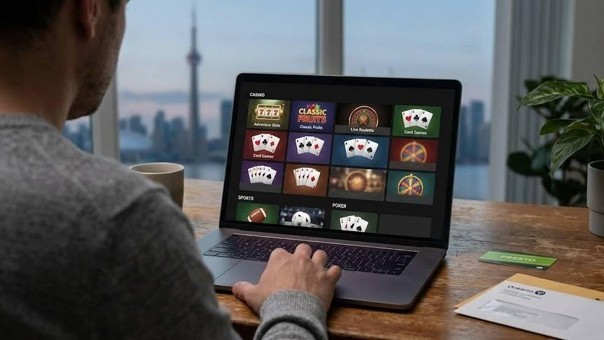
Dominance in the casino vertical is evident in more than just revenue numbers. It is evident in how the product has adapted to occupy that position. In the first year of operation, approximately 40% of all casino bets were placed on slots, with live-dealer table games accounting for approximately 30% of the bets. This distribution reflected the ease of playing slots as well as the interest in the social element of live play. That interest in live play has only increased. Initially, a significant number of bettors were playing slots. Over time, they branched out to other betting formats such as live roulette, live game shows, RNG table games, and crash games. The betting sites with casino offerings have catalogs wide enough to accommodate that progression. Swiper casino covers that progression from traditional slot games to live dealer games. It offers the range of casino products that Ontario players have come to expect after the first four years of a competitive market. In order to retain players, casino operators in this competitive market need to offer a wide range of casino products. The data for Ontario casino revenues suggests that operators with a product range that satisfies player interests are the ones that will succeed in this market.
Casino shoots to the top of the industry
From 2022 to 2026, the market saw strong, stable growth in a single direction. In the first year, casino’s C$855 million represented approximately 61% of the total market revenue with sports betting at 26% and poker at almost 3%.
The second year brought changes to the figures. Casino revenue almost doubled to C$1.6 billion, accounting for roughly 73% of the total market revenue of C$2.2 billion. Sports betting grew in absolute terms to C$523 million, but its total market share continued to decline. In the following fiscal year, casino revenue rose to C$2.40 billion, with a total market share of 75%.
The industry-changing month of March 2026 showed the scale of casino’s lead over the other verticals, with casino handle of C$8.33 billion, a year-over-year increase of 25.8%. It accounted for 82% of all iGaming revenue for the month, and 87% of all wagers. Once again, no other vertical came close.
What is the attraction? There are several factors. One is depth of product. The live-dealer offering has moved beyond traditional casino games of baccarat and blackjack. New casino game formats based on popular game shows have attracted a new customer base. So have crash games, which have a betting structure that is attractive to a particular customer segment that is comfortable with short-interval betting. New variants of casino table games can be offered through RNG, which removes the need for a live studio. Each new game offering pulls in a customer base that was previously unprofitable and increases the revenue base. This makes casino gaming increasingly difficult for other verticals to match.
Sports betting has hit its limit
Sports betting was already popular in Ontario, having gained even more popularity with the 2021 federal legalization of single-event wagers. Canadian customers finally had access to a sports betting product through a licensed channel for the first time. Sports betting products arrived quickly and included parlay bets, live in-play betting, and player props. Betting volumes were accompanied by aggressive marketing spending and betting-operator sports partnerships.
The data shows a strong first two years followed by slower growth. Revenue increased from C$368 million in year one to C$523 million in year two, then to C$724 million in year three, and finally to C$814.9 million in year four, an 18.6% increase from the previous year. By any metric, this is strong growth, but the year-over-year growth rate has slowed, and the overall trend has been decelerating. Sports betting currently makes up roughly 20% of the total Ontario iGaming revenue.
Looking at the US state markets provides some context. In a number of states, sports betting makes up 50% or more of the total online gaming handle. In terms of wager volume, Ontario sits at around 12%, which is a substantial difference. The difference in the markets is likely a result of the order in which the gaming industries launched in each state. In Ontario, casino and sports betting launched simultaneously. In many US states, sports betting launched before online casino, allowing sports betting to establish a customer base and gain market share before casino launched. In Ontario, casino had an inherent advantage over sports betting due to longer session times, higher bet volume, and a greater product offering. Sports betting is tied to live events and seasons.
This doesn’t change the fact that sports betting is a strong market. December 2025 numbers showed over C$1 billion in sports bets placed. This is real money and represents a significant, loyal, and engaged customer base. This market will be around for a long time. The cap this market has reached may actually be a structural feature of the Ontario market rather than a tentative limit.
Poker’s quieter corner
Poker in this form will always be a volume follower. Poker’s economics will always be different from betting, as the house only takes a small commission rather than the full value of each hand played. The Ontario numbers make this clear. In Year 1, poker generated C$37 million; Year 2, C$60 million; Year 3, C$66 million; and in 2025, C$70.2 million, a 3.7% increase from the previous year, with less than 2% of the total market revenue.
Handle tells an even flatter story. Poker wager volume was C$131 million in June, C$132 million a year later, and C$126 million in June 2026. In a market that saw a major boom and added billions of dollars in handle every month, poker was essentially stuck in the same place for two years.
The core difference is important here. Peer-to-peer poker relies on player liquidity; there need to be enough active tables at various stake levels during the hours a player wants to play. Ontario has a closed provincial player pool, so its player liquidity is shallower than in an open player pool. Skilled recreational players are able to find poker games, and tournament players are able to find events. This vertical has its community, and it has held onto it. What poker has not done is keep pace with the rest of the market, and at this point, that seems to be the norm rather than an exception.
What the Balance Reveals
Most industry observers did not expect a casino-to-sports-betting-to-poker ratio of approximately 75-20-2 when Ontario launched. The initial excitement surrounding the new sports betting opportunities and the expectation of strong sports betting volume from Canadian customers lent themselves to the idea of a more even contest. This has not been the case.
What the current situation has shown us, more than anything else, is that the Ontario player base has developed. In a new or growing market, customers usually engage with betting through sports betting opportunities because the experience feels more familiar; customers are often loyal to a sports team, understand the game, and are used to the concept of a win or a loss. Betting in a casino encompasses a broader range of games, and customers need to find a game or a betting style that aligns with their preferences. This takes time, and after four years, players have done so on a broad scale.
The other signal concerns user behavior during sessions. There is a natural ebb and flow to sports betting. There are busy days with multiple games and then quieter days with no action. This is not the case with casino gaming. Players can log in anytime, and there is no session pressure to log out. The platform can allow players to play for as little as 10 minutes or as long as 3 hours, and nothing on the platform encourages players to log out. This is a good structural design that ensures players continue to use the platform, and the compounding revenues prove this to be true.
How Ontario Now Compares to the World’s Most Mature Markets
By international comparison, the Ontario market resembles more established European markets where casino has a dominant position. In the UK, Sweden and Denmark, for example, casino typically accounts for the lion’s share of the online gaming revenue, with sports betting making up a meaningful, but clearly secondary, vertical. Ontario has achieved this market shape more quickly than most, primarily due to the simultaneous launch of casino and sports betting, and the aggressive post-launch product development of the former.

The road from novelty to normal
Just four years ago, the regulated iGaming market in Ontario was a new phenomenon. It was a completely new environment for both the regulators and the operators. Players were entering a newly regulated market. In 2022, the market had merely to exist and to attract players’ attention.
The market has far exceeded the most optimistic projections from just a few years ago. The total handle, revenue base, and active player count have all exploded. The product mix has become clearer. Casino has established its dominance by attracting and keeping players, who then use the different formats within casino offerings, resulting in sustained revenue growth that has outperformed the majority of regulated markets.
Sports betting has established itself as a strong secondary vertical with an engaged, fast-growing customer base. It complements casino offerings and will continue to grow with the international and Canadian sports schedules. Poker has established a vertical with a loyal player base and stable, yet limited, revenue stream.
The rest of the Canadian business community is beginning to understand the truth that Ontario’s iGaming market is one of the fastest-growing in North America, and the way that market settled, heavily weighted toward casino with sports betting as a complementary vertical, gives important insight into player preference when both products are available, well-marketed, and built to a high standard. Markets that adopted Ontario’s regulated model should expect a similar outcome. In 2026, casino’s dominance in Ontario’s iGaming market is not an anomaly. It is a clear example of a maturing market.