Weekly Regional Business Intelligence
|
|
|
Written by Kieran Delamont, Associate Editor, London Inc.
|
|
|
City staff recommend against Farhi’s Westmount office bid
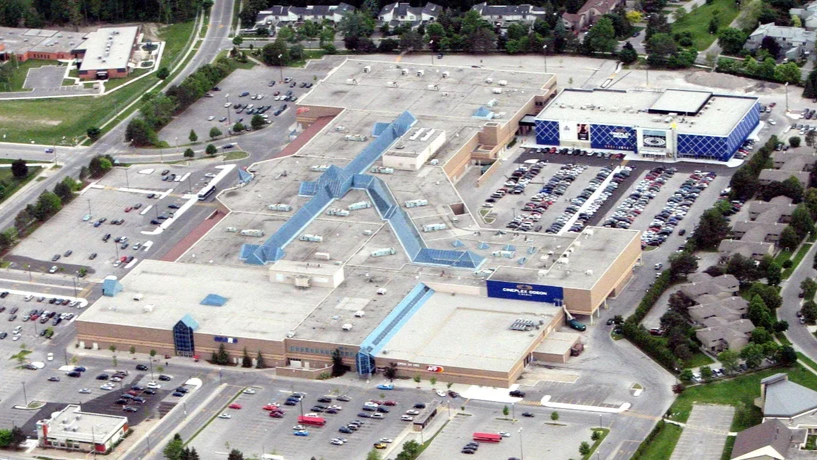
City staff are recommending London’s planning committee reject Farhi Holdings’ bid to rezone Westmount Commons mall for up to 242,000 square feet of office space, including a single 135,000-square-foot building reportedly earmarked for Carfax Canada. The tech firm is said to be looking to move as they outgrow its space at 100 Kellogg Lane (where it still has a few years remaining on its lease, it should be noted). Staff said in their report that that amount of office space belongs downtown, not in the suburbs, a position Mayor Josh Morgan backed. “This proposal would undermine the role of downtown as a primary office destination. The density is the problem. There has to be a compelling reason, and it is not there at this moment,” he said in an article from The London Free Press, adding that he wants to meet with Carfax to make the case for a downtown site instead. Councillor Steve Lehman, planning committee chair, opposed intervening. “I will not risk losing 800 good-paying jobs,” he said. Carfax said only that it is “proud to call London, Ontario home and intends to continue growing our presence in the city,” and that no decisions have been made. The planning committee will be voting on staff’s recommendation next Tuesday.
The upshot: Right now, office space at Westmount is capped by a 2024 Ontario Land Tribunal settlement between the city and the mall’s then-owners (the owners were trying to develop over 300,000 square feet of office space in a mixed-use development). At the time, Shmuel Farhi opposed the rezoning of the mall, and urged council to reject it, stating in a letter to council that “the core should maintain its status as the home of premium office space.” Now, as the owner of Westmount, he’s changed his tune. Staff aren’t the only ones against the rezoning. City staff also heard from Robert Klimov, managing partner at Bellridge Capital, owners of Citi Plaza. “If council permits yet another significant expansion of office permissions at Westmount Commons, it would become increasingly difficult to refuse similar requests in other desirable commercial areas of the city,” something he warned would lead to a “gradual migration of London’s office market away from downtown.”
Read more: City Staff Report | London Free Press
|
|
|
Two towers, 1000-plus units, no balconies, 21 parking spaces. Will it fly?
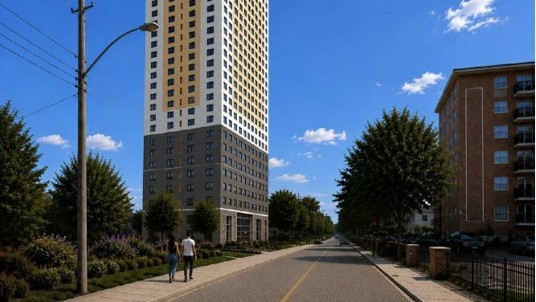
Foundation Capital, a Southwestern Ontario real estate investment firm, is proposing a new high-rise tower project (comprising two buildings of 28 and 26 storeys apiece) at Wellington Road and High Street in Old South (rendering pictured). The design stats might raise some eyebrows: 1,004 rental units, capacity for around 500 bikes — and a whopping 21 parking spaces for cars. Oh, and the units also have no balconies. The idea behind the proposal, Foundation says, is to cut building costs and then bring the units in at below-market rents. “We’re not a luxury developer… but we’re scratching a lot of itches that the city has right now,” principal Jeff Wybo told The London Free Press, adding that the project would provide “roughly 1,000 units that will provide affordable housing to Canadians, at market rent or below market rent.” Development manager Michael Nemanic put it like this: “If we just put in, let’s call it 500 parking spaces, well, what’s the point of being next to transit? People are just going to take the car.” He told the Free Press that balconies and parking spaces can cost up to $30,000 and $60,000 per unit and space, respectively, and create ongoing costs. “We’re trying to create the conditions where, when the city talks about transit-oriented development, we’re raising our hand and saying that’s exactly what we’re doing.” Ward 11 Councillor Skylar Franke said she hasn’t made up her mind on the proposal — she called the parking ratios “pretty stark” and said the design amounts to “a large rectangular box without any balconies or any other architectural value.” The applications go to a public meeting on September 29, and if approved, the firm hopes to break ground next summer.
The upshot: Well, why not try it? Urban planners, policymakers and housing advocates like to tinker with all sorts of policy levers, like eliminating parking minimums and building near transit, in order to encourage developers to do things that bring down costs. Yet for the most part, developments in Canadian cities stick to a well-worn playbook. Here, then, is a developer straying outside the box somewhat, hoping to actually make that idea work. The concept of a no-frills building with next to no parking does have some grounding in reality — near-zero-parking buildings have worked to make more affordable units in other jurisdictions. Whether it works as a whole package — a very dense development in a city that is car-dependent — is another question. Foundation Capital is more of an investment firm than a real estate developer, historically, but is moving into the development game with a clear thesis in mind (it’s also interesting to note that former London mayor Ed Holder recently joined the company as a strategic advisor). “Canada’s core workforce has nowhere to live,” they wrote on an investment page. “Canada’s core workforce makes between $25 and $36 an hour. At 30 per cent of income, they can afford $1,250 to $1,875 a month in rent. The government knows this is a crisis. That is why CMHC is offering the most favourable construction financing in Canadian history to developers who build purpose-built rental housing for this exact market. Foundation Capital is building to meet that demand.” The timeline here suggests this will be a development that heads to the new council, so we’ll have to see how amenable they are to this project’s eccentricities.
Read more: London Free Press | Foundation Capital
|
|
|
Is this retail protest a harbinger to fall’s primary election issue?
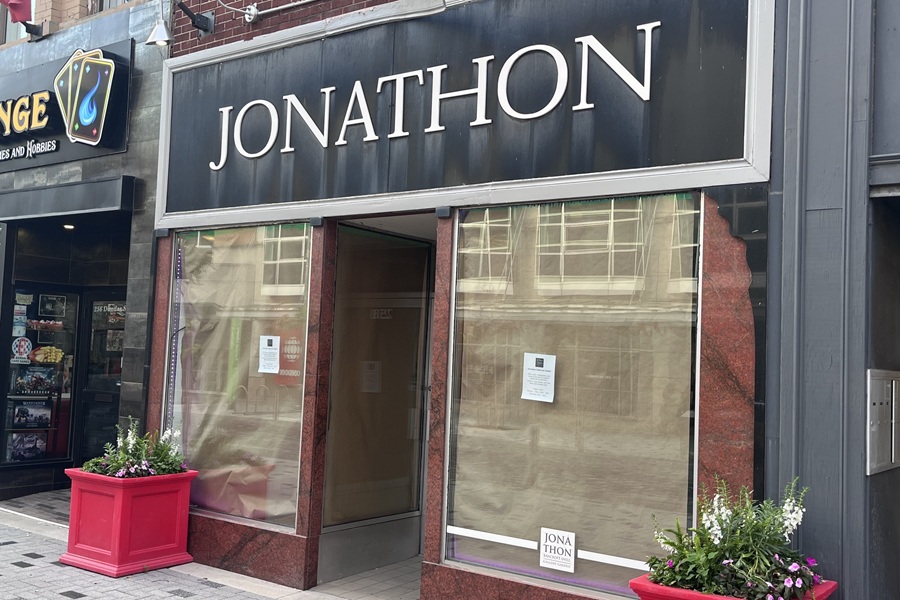
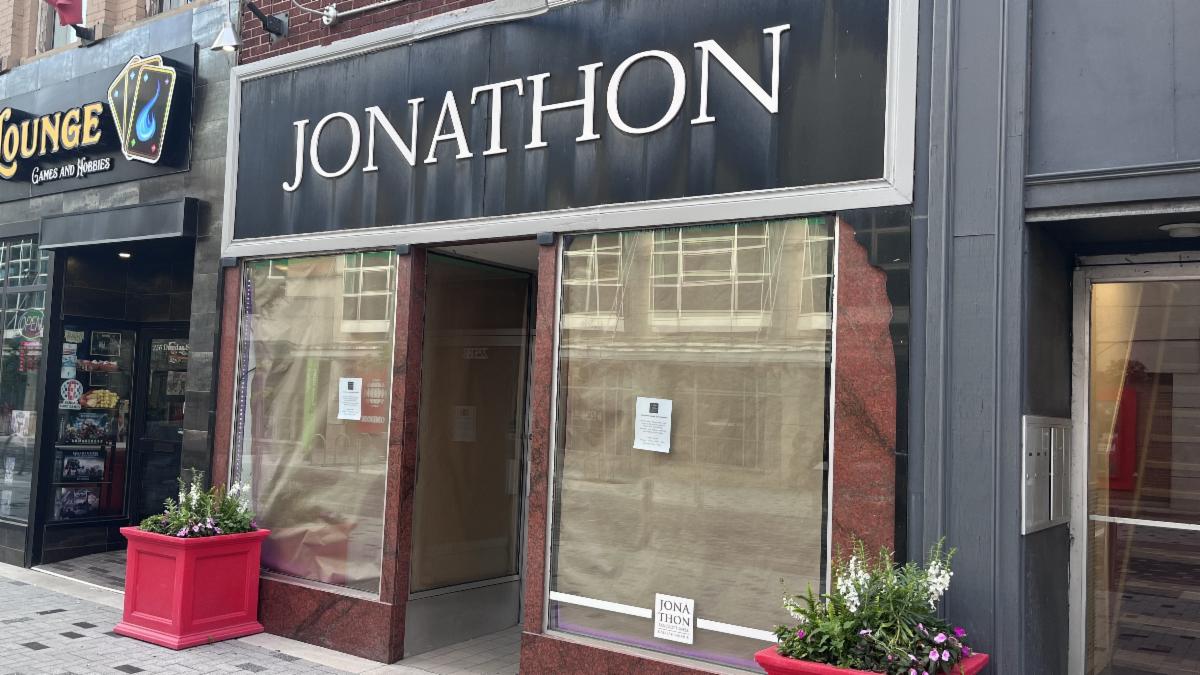
The Jonathon Bancroft-Snell Gallery isn’t closed. It just looks like that, due to the brown paper covering the windows — a political statement, manager Brian Cooke says, over the state of downtown. “If you don’t use the downtown, this is going to be the future of all the businesses down here,” Cooke told CBC News London. The ceramics gallery, open since 2000, is “within a hair’s breadth of actually closing,” owner Jonathon Bancroft-Snell said, adding that last week it rang up just two sales, both to out-of-towners. “We’re here 52 weeks of the year. We’re open six days of the week,” he said. “The only way that a downtown retains vitality is when people use it.” Ward 13 Councillor David Ferreira said the stunt seems to be grabbing people’s attention. “I think he’s calling out something that is true,” Ferreira said. “There’s a lot of positive things happening around here. There’s lots of really resilient people who live here, resilient business owners who have businesses here, employees who come to work at those businesses. Some of the strongest Londoners in the city are downtown.” Cooke told CBC he’s hoping the protest attracts a few more people downtown, at least. “We need your help,” he said. “Downtown needs your help.”
The upshot: Expect to hear a lot more about downtown businesses in the coming months as we approach this fall’s municipal elections. London’s core vacancy rate has remained among the highest in the country for much of the past four years, which, tied in with the visibility of social problems, is likely to be a hot-button issue for candidates and incumbents. “I think there’s some impatience. Listen, it’s not an easy situation, I understand that, I’m very sympathetic to council — but the fact is, I think a lot of people in the public think there’s a problem, and are not happy about the situation,” said former city councillor and urban development consultant Gord Hume, speaking to The London Free Press. “It’s very clear that downtown still is facing a lot of challenges, and so I think some challengers might feel that often opens up an opportunity for them to make a case that they could advocate better for downtown than the incumbent.”
Read more: CBC News London | London Free Press
|
|
|
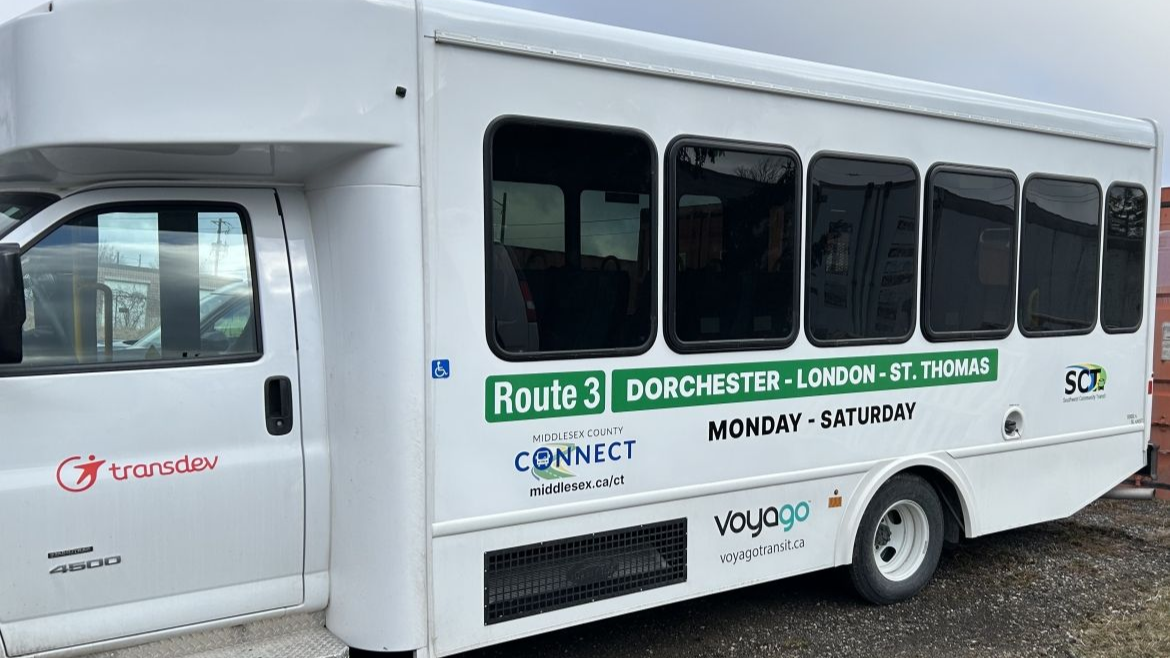
Middlesex County Connect adds operating hours, additional stops
Middlesex County Connect, the inter-community bus service linking London to smaller regional towns, says it is adding 1,124 service hours a year and reworking all four of its routes as it expands and solidifies its network after a third-party review. “This service is very important,” said Demetri Makrakos, community transportation project manager at Middlesex County, speaking to CBC News London. “It’s an option that has not existed in the past, and the changes we’re making to make it better were very easy, from a data-driven perspective, to make.” The changes include adding stops at higher-traffic locations (like Victoria Hospital, White Oaks Mall, Richmond/Oxford and St. Thomas’s Fanshawe College campus), standardizing daily schedules and streamlining routes. “It is data-driven and suggestion-driven, and there were reports that suggested that we should be looking into these certain areas,” Makrakos said. “It’s a fairly easy decision to remove stops that are only accounting for two per cent of ridership, take that extra 20 to 30 minutes back onto the route so the service can be more efficient and then add another stop that’s along the way.” Key to the redesign is maintaining the cost — almost all of the trips within the Middlesex County Connect network will still only cost $5 each way.
The upshot: The little regional transit network, which has survived largely on provincial grant funding since launching in 2021, has done well to establish itself as a piece of useful infrastructure in the region. According to Makrakos, ridership grew substantially last year when new routes were added to St. Thomas and Sarnia, to around 20,000 riders — a fair bit more than the 15,000 that was estimated in a 2025 staff report to the Middlesex County government. Last year, the county applied, and was approved for, $3.4 million in funding through 2030, although the grant only covers up to 50 per cent of the service’s costs, with municipal funding and rider fares needing to make up the rest. With the absence of any other regional transit in the area, there’s a desire to see this service remain viable — and if Makrakos’ ridership figures are accurate, it looks like demand is still growing, so now is probably a very good time for the service to take a step up in terms of efficiency and maturity, which seems to be the goal here.
Read more: CBC News London | Middlesex County
|
|
|
Downtown office vacancy shows signs of life in Q2
London’s downtown office vacancy rate slipped below 30 per cent in Q2 for the first time since late 2024, landing at 29.6 per cent — down nearly two points from 31.5 per cent in the first quarter — according to the latest CBRE commercial real estate report. About 80,000 square feet of downtown space was leased or otherwise taken off the market over three months, which CBRE’s London vice-president Greg Harris credited to companies pulling staff back in. “It’s more of a macro-economic thing that’s happening with the desire to move away from 100 per cent remote, and to more of a structure hybrid,” he told CTV News London. He said elsewhere that five-year leases signed during the 2020 pandemic are now coming up for renewal, and some companies are now looking to expand. “There has been good activity,” he said. That’s good news for downtown business owners. “Between the two office towers, there’s 5,000 people. So even if 10 per cent of those go out for lunch, that’s 500 people,” Shane Kenneth of Coffee Culture said, referring to the London City Centre complex. “Having everybody back, it breathes new life into the businesses, ‘cause we were struggling.” Some of the improvement is technical, with a couple downtown offices seeing space converted to other uses — golf simulators and lounges at London City Centre, and office-to-residential conversion projects on Dundas and Dufferin both contributed to a drop in vacant space. “There are rumblings of further conversions coming,” Harris told The London Free Press. “I know there are talks with landlords because the last few have been successful.”
The upshot: London is keeping up with the national trend, which has seen slow but steady improvement in terms of downtown vacancy rates. London’s core was the biggest mover in the Q2 report, CBRE notes, with the vacancy rate dropping nearly two points. (That cuts both ways, though — it also noted that the suburban vacancy rate jumped by over two points, though that is largely due to Fanshawe dumping its south campus.) Under the hood, CBRE’s figures show there’s a flight to quality, with Class A real estate having only a 21.7 per cent vacancy, while Class B/C spaces had a 35.6 per cent vacancy — a trend being seen across Canada. “There is a massive gap between the trophy office that’s in demand and practically full, and the rest of the market that’s grappling with higher vacancies,” said Adam Jacobs, research head at Colliers Canada, in The Globe and Mail. Still, Harris noted that London’s downtown has been recovering for a full year at this point, with momentum still pushing in the right direction. “We have had new leasing activity … It is a significant amount, and a lot of that has been in the works for months, if not longer,” Harris said.
Read more: London Free Press | CTV News London
|
|
|
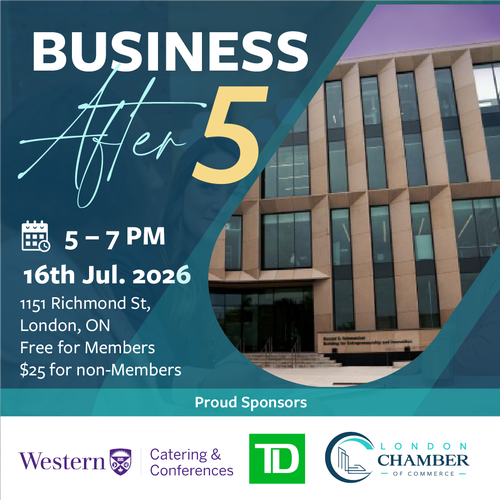
Dispatch: July 10, 2026
A summary of recent business appointments and announcements, plus event listings for the upcoming week.
View listings here
|
|
|
|
|