

Why a poker tournament win is not the business it looks like
Headline poker payouts hide a hard cost structure of buy-ins, variance and investor splits
EACH SUMMER THERE will be some headlines about: “somebody won 8 figures playing cards in Las Vegas.” It looks like an economic outcome. In reality, it is no different than buying a winning lottery ticket that was paid for with borrowed funds; and the individual who has this ticket gets to keep a portion of what is listed as the amount won. Where real economics of tournament poker exists are the difference between the number shown on the screen and the number in the player’s account. And from here you can see that high variance venture financing is similar to the economics of tournament poker.
The Difference Between the Buy-In and Prize Pool Numbers
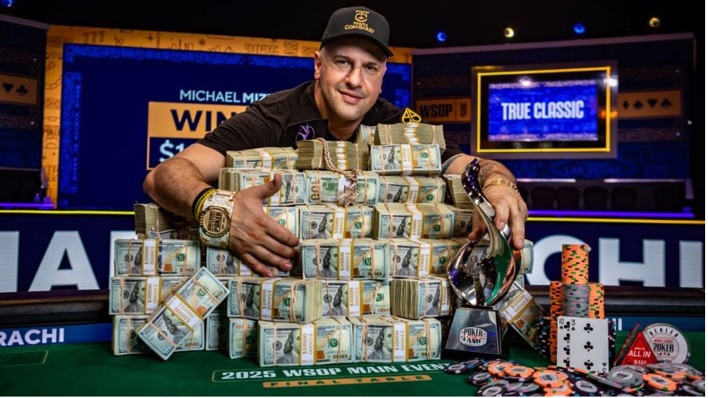
First consider the numbers to be used as a reference point. The 2025 WSOP (World Series of Poker) Main Event had 9,735 players each paying $10,000 to enter and created a total prize fund of $90,535,500. Michael Mizrachi won the tournament and received the advertised $10 million first prize.
Now look at the other side of the equation. Only 1,461 of the original 9,735 players earned some sort of payment (in the money). All others were sent home without anything. At least there were prizes awarded down to the last place money earning player who received a check for $15,000. That means they will earn $5,000 above their entry price and have already lost money when you consider the cost of one flight or hotel room and the time it takes to play all four days.
Variance Is the Main Cost Line
In essence, about 85% of every Main Event field will lose their buy-in. The percentage doesn’t change too much when you’re a skilled poker player. A great player may move the needle by a small amount; however, even a very talented player will still bust most tournaments he/she enters.
This creates a financial picture most businesses wouldn’t support. An individual’s costs (tournament fees) are consistent and predictable each week. Revenue (payouts from a tournament), on the other hand, come very infrequently, randomly and in significant amounts. If a baker has a bad month, it could cost them money, but if someone playing tournaments has a bad 18-month period, it is because something was done incorrectly.
Selling Action to Reduce Variance
Two structures dominate, and both will look familiar to anyone who has raised money. Both are traded through dedicated marketplaces now rather than settled with handshakes, and much of the volume that builds a player’s track record in the first place happens online, where a rotating tournament schedule on sites such as Bovada produces sample sizes a live circuit never could.
Selling the downside is the first method. In this method a player sells a percentage of his or her own buy-in. For example, if a buy-in is $10,000 and the player will sell 10 percent, then he or she will get $1,000 and receive 10 percent of all the money the player makes. Players who have a history of successful investing charge a fee above the cost of buying into the investment. This fee is referred to as markup. If a player charges 1.17 markup, the $1,000 for 10 percent of the buy-in would be raised by the markup amount; therefore, the $1,000 becomes $1,170. The entire markup amount is paid to the player and is based on their previous returns (historical) which are based on data that also contain noise.
Backing is the second type of investing. In backing, an investor pays for each buy-in made by the player and splits the profits equally. Each time the player loses, losses are accumulated as a running “makeup” debt owed by the player. The debt can only be paid back through future profits prior to any profit being distributed to the player. A player with a large accumulation of makeup is essentially working without compensation and may find it difficult to find another investor willing to take over and provide them with a better opportunity.

The Prize Is a Big Number but Not Always a Big Return
Combine all those numbers, and it does not take long for an eight figure headline to be reduced significantly.
If the winner was fully self-funded, the $10,000 buy-in reduced the $10 million gross prize by only 0.1% before other expenses and taxes. The retained payout could be much lower if the player had sold action or was subject to a backing agreement. Add on top of that, multiple month’s worth of buy-ins with no return, plus travel costs to get to the event location, hotel stays in cities which will charge you for each night you stay there (and will likely overcharge), plus taxes, and the tax treatment can vary depending upon your state or country of residence, as well as where you won the money.
All of these things are known. None of them make headlines. The number that makes the news is the amount of the prize, but it is rarely if ever reported as the total return to a player.
The Organization Isn’t That Rare
It’s really the typical organization, once we take the deck away from it.
An operator with some reasonable chance of success and no money to back it sells equity to people that are spreading risk through investing in lots of operators. The investors are able to get diversified risk that the operator can’t. They use historical performance for pricing, which is a poor indicator of future outcomes in a very short time frame. There are debt-like mechanisms like makeup locks, that keep the operator in place if they lose money. Everyone is trying to make money off an outcome where almost all attempts fail, but every so often, someone has made multiples. Venture funds follow this pattern. Film slates, drug development and oil exploration also follow this same type of model. The only difference is poker does it at a pace fast enough to have a complete cycle occur within a single summer.