
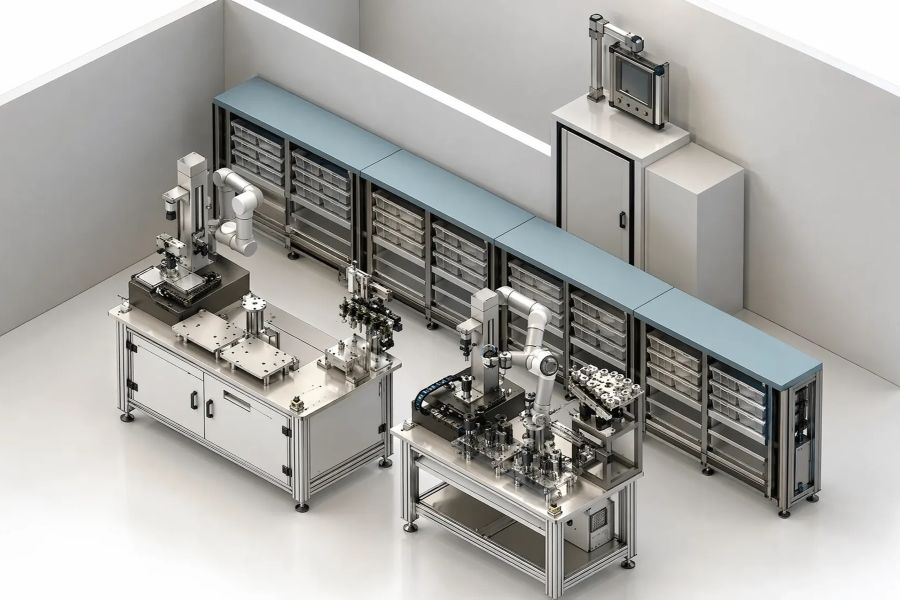
System integrator Singapore choices for custom machinery
A practical custom machinery decision begins with constraints, not equipment categories
BUYING PRODUCTION EQUIPMENT is not a contest between ordinary machines and impressive custom engineering. It is a decision about fit. A standard machine can be the strongest investment when the product, presentation, environment, and quality checks already match its assumptions. Custom machinery earns attention when those assumptions conflict with the way the business must actually produce.
During early discussions with a system integrator Singapore, ask the vendor to make that conflict visible before proposing a machine. The useful question is not whether a bespoke cell can be built. It is whether specific constraints change the mechanics, controls, validation, or service access enough that adapting a catalogue platform creates more cost and risk than designing around the process.
Mechanical Design
Consider a flexible medical component that arrives in bulk. It may tangle, deform under a hard grip, or present several plausible orientations to a camera. The problem is not solved by selecting a faster robot. Feeders, nests, contact surfaces, release paths, and inspection views must work as a set. If the part enters inconsistently, every station downstream inherits uncertainty.
A custom design can stabilise the part earlier. The feeder can restrict its possible poses, the tooling can support sensitive surfaces, and the transfer path can preserve orientation. That mechanical discipline may reduce the amount of software required to interpret exceptions. It also gives the acceptance test something concrete to measure: presentation rate, damage rate, and successful transfer under the agreed product range.

Cleanroom Rules Reach Materials and Service Access
A cleanroom requirement is not a label applied after the layout is finished. It affects exposed materials, surfaces that collect particles, pneumatic exhaust, cable routing, and how a technician reaches a component. The easiest actuator to service in an ordinary factory may be awkward when access must stay outside a controlled zone.
Motionwell Automation describes a medical-device project using cleanroom-suitable materials within a 12-station system. The useful commercial lesson is the breadth of the constraint. Cleanability and access influence the frame, guarding, component choice, and planned maintenance position. Treating them as a final material substitution can force expensive redesign after the sequence is already fixed.
Traceability Changes Controls and Validation Work
Traceability adds more than a barcode reader. The control system must know which unit reached which station, which recipe applied, what result was recorded, and what happened when a check failed. The machine also needs defined behaviour when identity is unreadable or when a product returns after intervention. Those paths must be designed before records can be trusted.
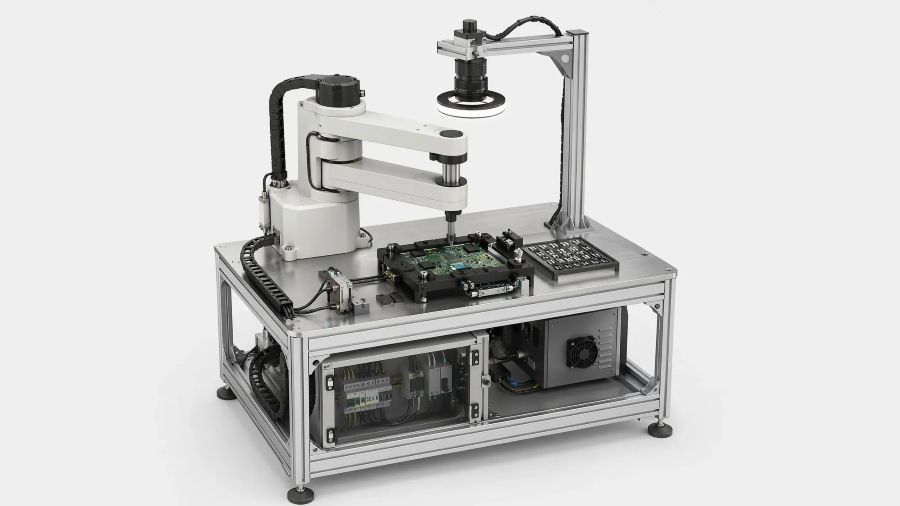
The medical-device system presented by Motionwell Automation combines SCARA handling, feeder systems, vision, multi-station processing, and traceability. Its published 15-second cycle is a project example rather than a benchmark for another factory. What transfers is the integration problem: physical progress, inspection evidence, and product identity must remain aligned across the stations.
Compare Business Risk Across Five Buying Questions
A purchasing team can compare standard and custom routes without pretending to predict every engineering hour. Put five questions on the bid-review agenda: how far the product departs from the platform, how much process evidence is required, which interfaces are already stable, how operators recover normal interruptions, and who owns the final performance test. The answers show where apparent savings may reappear as modification risk.
| Buying question | Standard machine is stronger when | Custom machinery is stronger when |
| Does the product fit? | Size, orientation, and contact rules match proven tooling | Handling changes the feeder, nests, or transfer path |
| Is the environment ordinary? | Materials, access, and utilities match the platform | Cleanroom or facility rules reshape the architecture |
| How much evidence is required? | Existing checks and records satisfy acceptance | Unit-level identity and custom validation are essential |
| Are interfaces settled? | Upstream and downstream connections are conventional | Several machines, databases, or instruments must coordinate |
| Who owns commissioning? | The buyer can integrate and test separate packages | One party must prove the complete production sequence |
The matrix is deliberately operational. It does not award custom machinery points for novelty, and it does not assume a standard machine is simple to integrate. It asks where the unresolved work sits. If most risk is concentrated in product handling, environment, and traceability, a low equipment price can be followed by a long chain of modifications that nobody priced as one system.
Price the Engineering Change You Expect
Compare the two routes at the same completion boundary. For a standard machine, include special tooling, controls changes, guarding, upstream and downstream interfaces, validation support, and production ramp-up. For a custom route, include design review, build, software, documentation, training, and the agreed acceptance tests. A quotation that stops earlier in the process will naturally look cheaper.
Also price uncertainty by naming it. If three product variants have not been tested in the proposed feeder, record that gap and decide who will run the trial. If the factory database interface is undefined, do not bury it in a general software allowance. Named unknowns can be closed; a large contingency without an owner usually survives until commissioning.
Ask Who Owns Commissioning and Recovery
A cell can contain excellent individual machines and still fail its production test at the handoffs. One vendor proves the feeder, another proves the robot, and a third proves the inspection station, yet nobody proves an accepted product through all three. The purchase agreement should identify who owns the sequence, the site test, and the correction of interface faults.
Motionwell Automation describes full-cycle engineering across mechanical design, electrical work, PLC programming, vision, fabrication, and integration. That model may reduce handoff ambiguity when the project genuinely requires several disciplines. The buyer still needs a written test boundary: products and variants, run duration, accepted output, rejection behaviour, documentation, and the conditions that end commissioning.
Know When Custom Engineering Is the Wrong Fit
Custom machinery is a poor answer when the process is still changing weekly, product samples do not represent production, or the buyer cannot define an acceptable output. It is also hard to justify when a standard platform already meets the process and the only motivation is a more polished layout. Bespoke engineering cannot remove uncertainty that the business has chosen not to resolve. In those cases, a manual trial, small fixture, or configurable standard machine may create better evidence before a larger commitment.
Buy Custom Only for a Defined Constraint
List what the product demands, what the environment forbids, what evidence quality requires, and which handoffs must be owned as one system. Then compare standard and custom routes at the same tested-production boundary.
A standard machine deserves the advantage when its assumptions already fit. Custom engineering deserves its premium when the constraint cuts across mechanics, controls, validation, and service access strongly enough that piecemeal adaptation carries greater risk. Motionwell Automation’s medical-device example illustrates that joined problem, but the buying rule is universal: pay for bespoke design only when the process can explain exactly why it needs one.