Weekly Regional Business Intelligence
|
|
|
Written by Kieran Delamont, Associate Editor, London Inc.
|
|
|
Canada Rocket Company to build engine test site at YXU
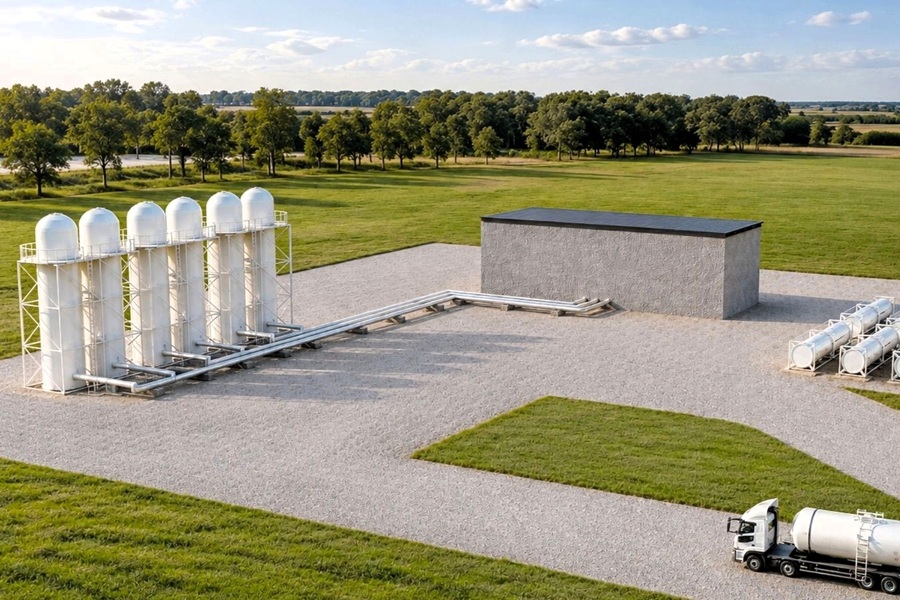
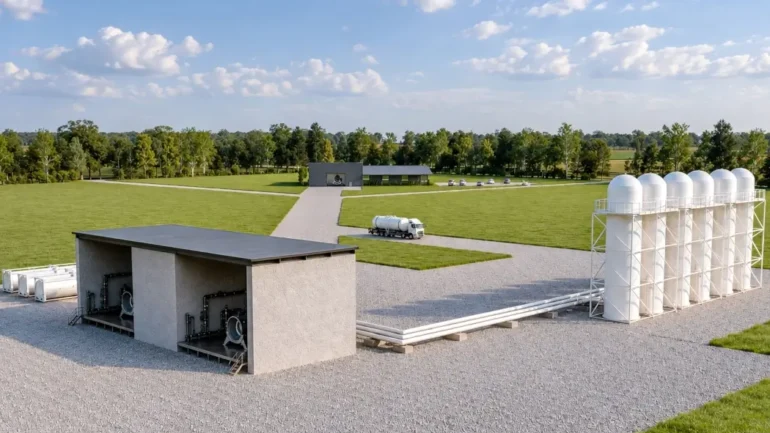
Canada Rocket Company (CRC), a Toronto startup founded in 2025, held a groundbreaking on Thursday for what it calls Canada’s first large-scale rocket engine test facility: a $30-million site at London International Airport (digital rendering pictured). The company is leasing 50 acres from the airport authority and says it will build an office and shop building there, plus up to three stands for “static tests,” in which the engines are bolted to rigs on the ground and blasted, CEO Hugh Kolias told The Globe and Mail. The facility will be named after moon man Jeremy Hansen, the London-born astronaut who flew around the moon on Artemis II earlier this year. CRC says it expects to hire about 40 people in London over the next 18 months and to be fully operational by 2028. The engines being tested are for a reusable rocket the company hopes to launch in 2032, which Kolias likened to SpaceX’s Falcon9 rocket. “The London International Airport, their team, as well as the London Economic Development Corporation, have just been absolutely fantastic to work with, and that’s really the core draw, and ultimately why we’re here,” Kolias told The London Free Press. “I think a lot of communities probably would have said that this is just too much work.”
The upshot: Canada has growing space ambitions, and this is the kind of project that will likely feed into a larger Canadian space sector in the coming years. In 2024, Canadian satellite firm Telesat announced it had signed financing deals with the federal government and Quebec provincial government to establish a Canadian satellite network to rival Starlink (something that PM Mark Carney told the New York Times last week we’re hoping to diversify away from), but it still needs to rely on SpaceX rockets to get the satellites in orbit. (The American reliance for rocket launches is something that has been criticized, including in a Walrus article published Thursday.) The Canada Rocket is one of the rocket companies that will hopefully be able to fill that gap. The Department of National Defence has a ten-year lease on a launch pad out in Nova Scotia, but — as the Walrus put it — “a launch pad without a working rocket is an unusually expensive slab of concrete,” so there’s lots of interest in seeing homegrown rocket companies start to take flight.
Read more: Globe and Mail | London Free Press | Canadian Defence Review
|
|
|
Multiple Western buildings to be demolished to make way for landmark Bioconvergence Centre
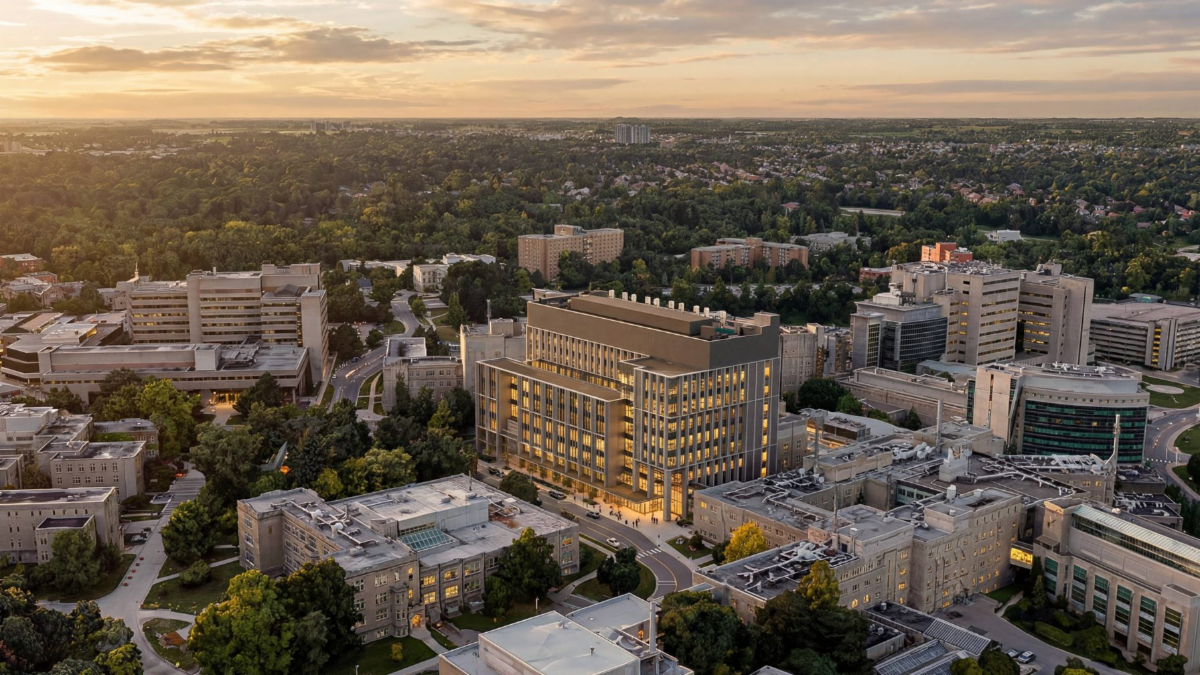
Western University’s board of governors has approved plans for an eight-storey, 383,000-square-foot research building in the middle of campus, called the Bioconvergence Centre (rendering pictured). The school said the building will be the first facility in Canada built specifically for ‘bioconvergence’ — Western’s term for bringing biologists, doctors, engineers and computer scientists under the same roof. As the university puts it, the building will be “purpose-built to explore an emerging frontier that integrates biology with medicine, engineering, computational sciences and advanced technologies, such as AI, to accelerate commercialization of real-world interventions and treatments.” The Bioconvergence Centre will go up between the Schulich School of Medicine & Dentistry and the Faculty of Science, and the school told the Western Gazette the Natural Sciences Centre building, the Kresge Building, the Molecular Biology Laboratory and part of the Health Sciences Addition building will all have to be demolished to make way for the new build. Construction is set to start in 2027, with an opening in 2031. The university says the project, one of the largest capital projects in the school’s history, will support 400 to 550 jobs a year while being built.
The upshot: You can read a lot into what Western is hoping to prioritize in the coming years by the way this building has been pitched. In a Schulich article from last fall, Western president Alan Shepard called it a “transformational investment in our future,” while Schulich Dean Dr. John Yoo said it was a “key part of our plans to ensure that our learners, researchers and scientists aren’t just equipped to meet the future — but to shape it.” In short, Western is hoping that by bringing a bunch of cutting-edge sectors under one roof that the pathways to commercialization and marketability for their research are shortened considerably. School officials say this is something they’re doing to meet market needs. “The problem is not a lack of talent, but the gap between discoveries and reaching the market and patients,” said provost Florentine Strzelczyk, speaking to Western News. “Western’s Bioconvergence Centre is designed to close that gap.” A total cost for the building hasn’t yet been publicized, although the size and scope of this building probably suggests costs running into the hundreds of millions.
Read more: Western News | Western Gazette
|
|
|
Show me the money: Dream Lottery closes the door on house prizes
It’s just dreams on offer now, not dream houses. For the first time in its 30-year history, the Dream Lottery isn’t offering a house up as its traditional prize, the lottery announced last week. The winner of the twice-annual hospital fundraiser lottery (a joint venture between Children’s Health Foundation, St. Joseph’s Health Care Foundation and London Health Sciences Foundation) has customarily been able to choose between a new home or $1 million in cash, but will now simply get the cash. “We continue to survey our ticket buyers and increasingly everybody says, ‘We want the cash,’” said Michelle Campbell, president and CEO of St. Joseph’s Health Care Foundation, speaking to The London Free Press. “A house doesn’t actually appeal to everybody. Everybody speculates what their dream is going to be and it’s different for everybody.” The lottery has raised more than $68 million for patient care and research since it launched in 1996.
The upshot: The Dream Lottery foundation didn’t say how many of the past winners took the house versus the cash, although the move suggests the cash has been more popular. A 2012 article in The Globe and Mail, looking at the Princess Margaret Welcome Home Sweepstakes (which doesn’t offer a cash prize), found that most dream homes end up being sold relatively quickly by the winners. And a 2017 CBC article also reported that nine straight New Brunswick Hospital Home Lottery winners opted to unload the prize rather than move in, and found that resale value often came way under the stated value from the lottery. (There’s also the challenge of establishing homebuilding partnerships in an increasingly costly market.) So, the move to just offer the cash likely makes sense — although there’s sure to be a disappointed delegation of homeaholics and decoristas that eagerly awaited the Dream Lottery home tours each spring and fall.
Read more: London Free Press
|
|
|
LHSC helps pilot accelerated clinical trial program
A new $5-million program, piloted at London Health Sciences Centre (LHSC), will let drug companies and other trial sponsors start clinical trials at Ontario hospitals in as little as 45 days, according to Clinical Trials Ontario. Getting a trial off the ground normally means a contract, a budget negotiation and an ethics review, usually handled one after another, a process the group says can take three to six months, or longer in some cases. The new program, called QuickSTART, is being funded by the province and runs all of those steps at the same time. LHSC’s research institute ran the first study this summer and beat the 45-day target by a wide margin. “Our team was able to complete start-up in under 20 days,” said Dr. Chris McIntyre, interim vice-president of research at the LHSC Research Institute. “For patients in London and the surrounding area, this will mean faster access to trials and the innovative therapies they bring.”
The upshot: Clinical trials are a bigger business than you might assume — over five per cent of all clinical trials took place in Canada in 2025, according to Innovative Medicines Canada — and the ability to cut the paperwork to get them up and running could help attract more of them to Ontario specifically. In raw numbers, the number of clinical trials being initiated in Canada has been on a slight decline over the last few years, though it’s possible that’s partially a correction following a surge in trials in the early post-COVID years. North America itself is fairly stable, but an increasing share of trials are going to the Asia-Pacific region, at least according to Innovative Medicines Canada’s data. The ability to get clinical trials up and running within a month to a month and a half will be a major validation of the $5 million the province put toward QuickSTART back in 2024, part of a funding package provincial minister Vic Fedeli said “will truly take the life sciences industry in our province to the next level, making sure medical breakthroughs of the future are always possible here in Ontario.”
Read more: Fierce Biotech | Clinical Trials Ontario
|
|
|
London Hydro seeks rate hike to finance grid upgrades
Heads up: your juice bill is likely going up. London Hydro has gone to the Ontario Energy Board and asked it to approve a rate increase that would add about $6 a month to a typical residential bill, and around $6.82 per month to the average business customer — money the utility says it needs to replace aging equipment and expand the city’s grid. The application sets out 2027 rates and a five-year investment plan running through 2031, with an average of around $37 million per year going to equipment renewal and another $20 million a year to new capacity and automation. The utility points to population growth, new business connections and the spread of electric vehicles, heat pumps and electric transit as the reasons the grid needs the work. It also said the proposed increase was originally higher. London Hydro surveyed more than 12,000 customers in May, and “we also heard that affordability matters,” the utility said. “In response to that feedback, we refined our plan and reduced the proposed customer impact from approximately $8 per month to $6.01 per month for a typical residential customer.” Part of cost increase, the utility explains, is the cost of power grid materials: “Poles and many types of wire now cost roughly twice what they once did.”
The upshot: As one might expect, news of the power bill going up is not likely to be a popular headline. It certainly wasn’t popular with the around two dozen or so letter writers whose public feedback were included in the rate increase application. “Families are struggling to make ends meet. An increase at any level is detrimental to any resident that is barely making ends meet,” wrote one. “If you are not improving anything and only increasing the price, it’s not fair for the end user. Keep your prices the same, Canadians are already struggling to make it,” wrote another. You get the picture. According to London Hydro’s technical submissions to the Ontario Energy Board, it really does need the money. Its submission says it intends to spend around $490 million in capital by 2031, which is already short of the $621 million it has identified as its actual capital need, savings of around $130 million it says it can handle based on “reprioritized investments, optimized project scope and adjusted pacing,” and which results in about $2 per month being knocked off the proposed rate increase. The most pressing capital need identified is underground cables — London Hydro says around 475 kilometres of cable that is either already in a degraded condition or is expected to reach the end of its life within the next five years.
Read more: CTV News London | London Hydro
|
|
|
Fanshawe to train air force technicians at CFB Borden
Fanshawe College is set to start teaching aircraft maintenance on a Canadian military base through a new partnership with the Canadian Forces School of Aerospace Technology and Engineering (CFSATE) at CFB Borden, according to a press release from the school and the Department of National Defence. Under the deal, Fanshawe will deliver its aerospace curriculum inside the military training school. Royal Canadian Air Force aviation maintenance technicians will finish with recognized post-secondary credentials on top of their military training, the press release says. (CFSATE is the air force’s main school for technicians, based at Borden, near Barrie.) The official rationale is “improving training resiliency and interoperability between military and civilian aerospace training systems.” More details on the program, including the number of students, is expected to be announced on Friday.
The upshot: We’re hearing less and less about broad cuts being made at Fanshawe and more and more about new partnerships and ventures, mainly with the defence and aerospace industries, which is probably welcome news for a school dogged by its finances for the past few years. Fanshawe is following the money with partnerships like this, which is to say they’re leaning harder into their historic identity as a military-connected college and pursuing the free-flowing defence spending in Canada. Other colleges are following suit and cozying up to the armed forces, too. Earlier this year, Niagara College launched a drones and autonomous systems program within its engineering program, and the armed forces signed a similar partnership with Royal Roads University in British Columbia in April. Colleges are hoping to play a larger role in the defence investment, with Ontario’s defence strategy framework listing “enhance[d] defence focused learning opportunities in Ontario’s colleges and universities” as a key future priority.
Read more: Fanshawe College
|
|
|
Dispatch: October 2, 2026
A summary of recent business appointments and announcements, plus event listings for the upcoming week.
View listings here
|
|
|
|
|