

Crafting a future
With the craft beer industry facing a changing industry, 4EST Brewery’s acquisition of Storm Stayed Brewing signals a new approach to keeping the taps — and the business — flowing
IS THE CRAFT beer boom dead? Maybe. It certainly isn’t 2012 anymore. Over the past decade, craft beer has gone from counterculture to mainstream to an era of gimmicky excesses (pastry stouts, anyone?), before arriving at today’s landscape of consolidation and market realism.
Click here to view this article in magazine format
“Everybody is saying, why the f** are you buying a craft brewery? The industry is doing this,” says Joel Richer, gesturing to show a sharp downward slope.
He’s not wrong. More breweries are closing than opening, alcohol consumption is declining and tastes are shifting away from the big, brash beers that once defined the craft movement.
But Richer, co-owner of 4EST Brewery (4estbrewery.com) and the new co-owner of Storm Stayed Brewing, believes in craft beer’s future.
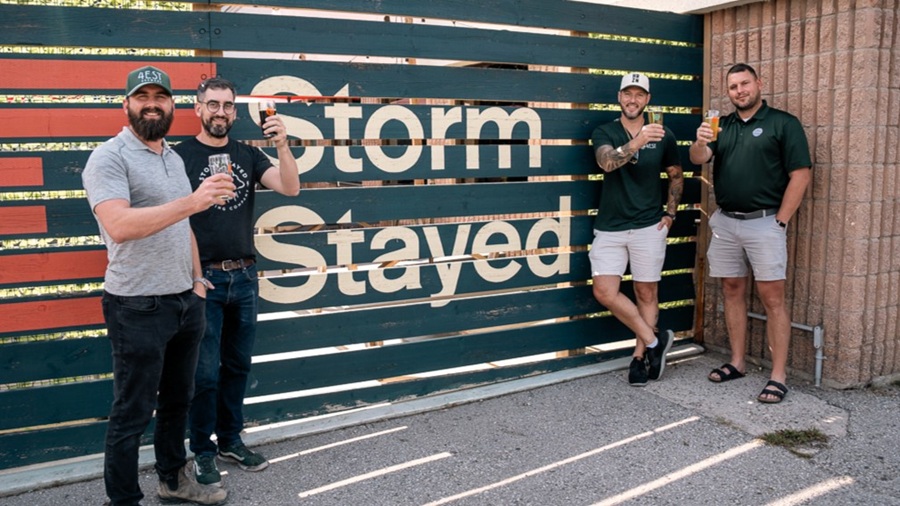
Photo from left: Myles Rombough, Justin Belanger, Joel Richer and Conrad Bedard
“If you do it right, and if you put in the effort and attention in the places where the industry needs to get evolved to, I think you can be successful,” he says. “And now, it’s about proving that theory.”
This fall, Richer and partners Myles Rombough, Colin Gunn, Conrad Bedard and Mike Jusczynski closed a deal for 4EST to purchase Storm Stayed, a small brewery and taproom on Wharncliffe Road South.
The two businesses already had a relationship, with 4EST contract brewing its beer at Storm Stayed. When the opportunity arose to purchase the brewery, Richer saw a natural fit.
“They, in my opinion, are the best craft brewery in London in terms of the quality of the beer,” he says. “It wasn’t like we were cold calling them.”
For 4EST, the acquisition represents a significant leap — from contract-brewed brand to brewery owner and taproom operator, bringing two distinct beer brands under one roof.
Story Continues Below
Their identities are complementary. While 4EST focuses on traditional styles such as pilseners, reds and lagers, Storm Stayed takes a more experimental approach, producing everything from jalapeño beer to honey beer.
For now, the priority is a smooth transition.
“We didn’t want to come in and blow everything up,” Richer says. “The idea is to keep it as business as usual for the first little while, get an understanding of where we can build efficiency, where we need to make changes.”
“You have to be tapped in as a businessperson to what is going on in the industry, and if you just lean on the quality of your product that’s often not enough” —Joel Richer
Some changes are already underway, including developing a kitchen. Others reflect a broader vision for the business. “I think there’s an opportunity to build this out more into a third space,” Richer says.
Storm Stayed already enjoys strong support from its surrounding community, something the new ownership group hopes to build upon. That could mean expanded operating hours, morning coffee service and a cocktail program drawing on Richer’s experience operating mobile bar business Bulles et Bières.
“Whether you want to have a coffee meeting, or you want to do a beer at lunch or you want to have something to eat and a cocktail, you’ll be able to experience that in our space in a seamless way,” he says.

The ambition reflects a changing reality for craft breweries. The days of relying on a loyal crowd of hazy IPA enthusiasts are fading. Today’s consumers are more selective, and experiences increasingly matter as much as what’s in the glass.
“What we’re seeing less with the younger demographic is, ‘This is my bar, I’m going to go here three days a week and have a drink.’ It’s more, ‘This event is happening, so I’m going to go have some drinks for that event,’” Richer explains.
For brewery operators, that means thinking beyond just beer quality to programming, atmosphere and broader customer appeal.
Story Continues Below
“You have to be tapped in as a businessperson to what is going on in the industry, and if you just lean on the quality of your product that’s often not enough,” Richer says.
The challenge, he believes, is retaining the loyal customers who helped build craft beer while giving new audiences reasons to discover it.
“The people that are currently there today that have kind of rallied around the craft beer community — you don’t want to alienate them. But you also want to create opportunities for other people to experience craft beer.”  Kieran Delamont