

How local businesses can improve delivery operations
Steps to improve delivery management and logistics for local businesses
LOCAL DELIVERY CAN become expensive long before a business realizes it has an operational problem. A few poorly sequenced stops, repeated delivery attempts, long loading times, and unnecessary driver calls can turn a profitable order into a low-margin one.
Restaurants, retailers, wholesalers, florists, pharmacies, and other local businesses need to treat delivery as an operating system rather than an extra service. Better results come from controlling the entire process, from order intake and route planning to proof of delivery and customer follow-up.
Centralize Delivery Management
Small delivery operations often start with spreadsheets, text messages, printed addresses, and drivers choosing their own routes. That may work with a handful of daily orders, but coordination becomes difficult as volume grows.
Using software for delivery management can bring route planning, dispatch, driver assignments, delivery tracking, and completion records into a more structured workflow. Spoke Dispatch, for example, includes route optimization, driver tracking, delivery status management, and proof-of-delivery functionality.
This is particularly useful when several drivers are working simultaneously. Dispatchers need to know which stops have been assigned, which deliveries are complete, and where problems are developing without calling every driver for an update.
Build Routes Around Real Operating Constraints
The shortest route on a map is not always the most efficient delivery route.
Businesses need to account for delivery windows, driver capacity, vehicle type, pickup locations, loading time, traffic patterns, and priority orders. A route that saves three miles but causes a driver to miss two scheduled delivery windows is not an improvement.
A driver should also receive stops in a logical sequence before leaving the facility. Reordering a route manually while already on the road wastes time and creates inconsistent arrival estimates.

Improve Address Data Before Dispatch
Bad address information causes problems that no routing algorithm can completely fix.
Apartment numbers, loading entrances, gate codes, business names, contact numbers, and delivery instructions should be captured when the customer places the order. Standardizing these fields reduces the amount of information drivers need to chase down later.
Local businesses should also review addresses before dispatch. A missing unit number discovered at 9 a.m. is easy to correct. The same missing information becomes expensive when a driver is already parked outside the building.
Reduce Failed Delivery Attempts
A failed stop creates more than one operational cost.
The driver loses time at the location, dispatch may need to contact the customer, and the package may need to return to the facility before being sent out again.
Customer notifications can reduce this problem. Send an order confirmation first, followed by an estimated delivery window and another notification when the driver is approaching.
For high-value or time-sensitive deliveries, confirm that someone will be available before assigning the stop to a route.
Standardize the Driver Handoff
Drivers should not leave the facility with incomplete information.
Orders need to be staged in route order where practical, and every driver should receive the same basic delivery information.
A Driver Record Should Include
- Customer name and address
- Contact number
- Delivery window
- Package count
- Special handling requirements
- Access instructions
- Payment status where relevant
- Required proof of delivery
Standardization becomes particularly important when temporary or part-time drivers are used during busy periods.
Give Dispatchers Real-Time Visibility
Dispatchers need to manage exceptions, not simply create routes at the beginning of the day.
Traffic delays, customer cancellations, vehicle problems, urgent orders, and incorrect addresses can all change the original plan.
When delivery progress is visible centrally, dispatchers can decide whether another driver should handle an urgent stop or whether customers need updated arrival information.
Without that visibility, problems are often discovered only after customers call.

Capture Proof of Delivery
Completed deliveries should create a reliable record.
Depending on the business, proof may include a customer signature, photograph, recipient name, timestamp, GPS location, or delivery note.
These records are particularly important when customers report missing items or dispute whether an order arrived.
Proof of delivery can also reveal process problems. If drivers frequently photograph packages in unsafe locations, for example, the issue can be addressed through clearer delivery standards.
Measure Delivery Performance
Businesses cannot improve delivery operations without tracking what actually happens on the road.
Do not look only at total daily deliveries. Measure efficiency at the route and stop level.
Useful Delivery Metrics Include
- Cost per completed delivery
- Deliveries per driver hour
- Miles per delivery
- On-time delivery rate
- First-attempt success rate
- Average service time per stop
- Failed delivery percentage
- Customer complaints per 100 deliveries
Track trends over several weeks rather than reacting to one unusually difficult day.
Control Loading and Staging Time
Route efficiency can disappear before a vehicle even leaves the parking lot.
If drivers spend 30 minutes searching for orders, checking labels, or rearranging packages, the business is paying for idle delivery capacity.
Create a defined staging area and organize orders by route. Labels should be visible without moving multiple packages.
For larger operations, record scheduled departure time and actual departure time. Persistent differences usually point to a warehouse or preparation problem rather than a driver problem.
Turn Delivery Into Part of the Customer Experience
The delivery itself is also a customer touchpoint.
Packaging should arrive clean and recognizable, and drivers should follow consistent standards when interacting with customers. Small branded details can reinforce the business without complicating the delivery process.
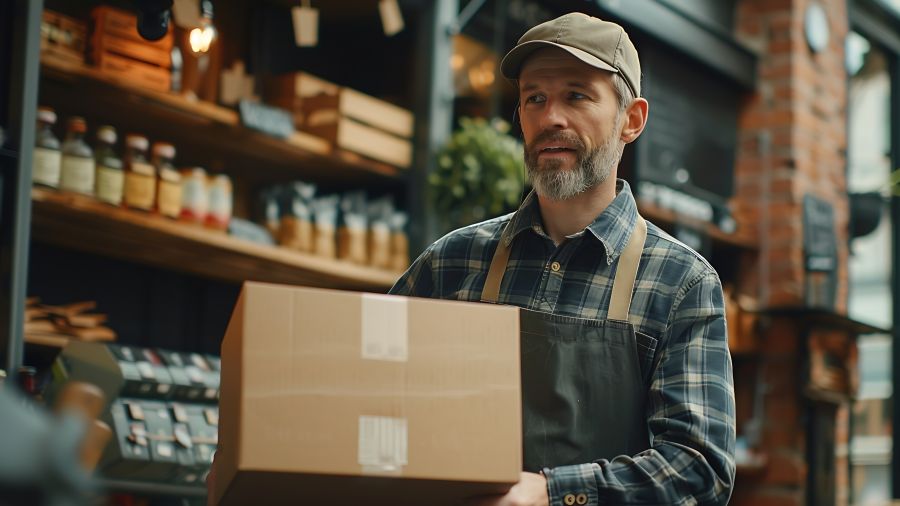
For example, retailers or subscription businesses can include custom keychains with selected orders, loyalty campaigns, new-customer packages, or promotional deliveries. A useful branded item can extend the customer interaction beyond the package itself without adding significant size to the shipment.
The key is to keep promotional additions operationally simple. Anything included with deliveries should be easy to inventory, pack, and replenish.
Match Vehicle Capacity to Delivery Demand
Using the wrong vehicle for the route creates unnecessary cost.
A large van running a handful of small local orders may use more fuel and be harder to park than necessary. A small vehicle overloaded with packages can create repeated returns to the depot.
Review route volume, package dimensions, weight, and delivery density before assigning vehicles.
Businesses with predictable weekly patterns can also match staffing and vehicle capacity to known peaks rather than reacting after orders arrive.
Review Routes After Completion
Route planning should not end when the driver returns.
Compare planned routes with what actually happened. Look for repeated detours, unusually long stops, missed time windows, late departures, and areas where drivers frequently encounter parking or access problems.
Driver feedback is valuable here. Mapping data may show that one route consistently takes longer, while the driver can explain that a particular commercial building requires 15 minutes for loading-dock access.
Those details should influence future planning.
Build Delivery Operations That Can Scale
Local businesses do not need enterprise-sized fleets to benefit from disciplined delivery management.
The basic principles are the same at almost any scale. Centralize delivery information, build routes around real constraints, improve address accuracy, track drivers, document completed stops, and measure performance.
Then fix problems based on operational data rather than assumptions.
A delivery process that works for five orders a day can break quickly at 50. Building consistent systems early makes it easier to increase volume without adding drivers, vehicles, and administrative work at the same rate.