
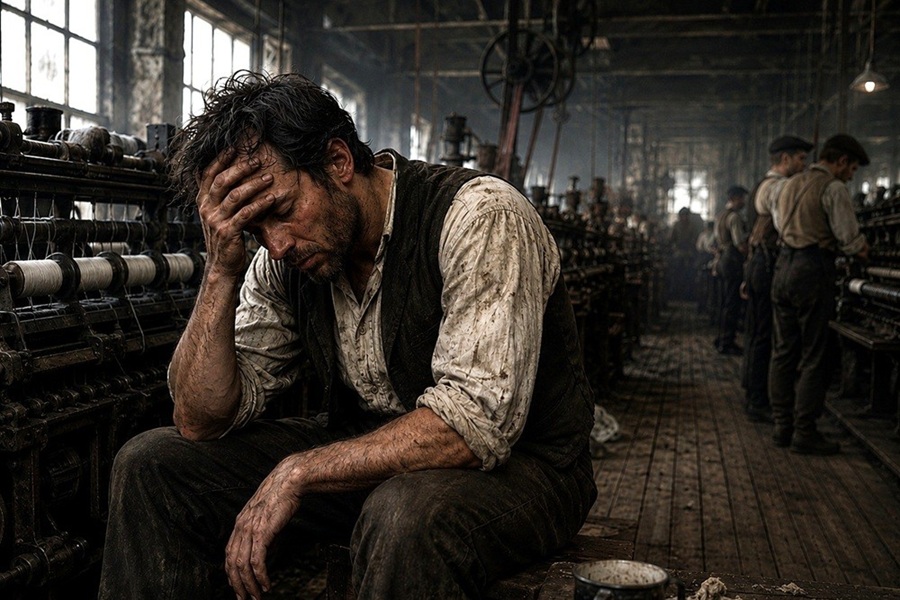
Ye olde burnout
You may think of workplace burnout as a modern-day affliction. Turns out the concept is centuries old
A FEW YEARS back, the term ‘burnout’ started to appear everywhere. Your cousin was burnt out; your coworkers were burnt out; you were probably burnt out. Over the last 10 to 15 years, burnout has become an unmissable part of the professional lexicon, and only seems to be growing in how and when it is used. (“If burnout had a publicist, this would be its breakout season,” wrote Psychology Today earlier this year.)
Click here to view this article in the London Inc. Worklife newsletter
While there is something particularly modern being invoked by the concept burnout, with its attachments to the long hours and psychologically taxing world of white-collar knowledge work in the 21st century, its roots go way back — back further than the digital era, back before it was classified as a health issue in 1990 and back further even than its inclusion in the Oxford English Dictionary in 1937, according to some research from Western University post-doc researcher Nathan TeBokkel.
“The term is even older than that,” TeBokkel wrote. “More than 200 years ago, agriculturalists and workers used the phrase burnt out to describe fertilizer kilns, fuel, matches, fires and the consequences of excessive work.”
“This structure hasn’t changed since the 18th century. Burnout is built into capitalism, not a problem capitalism is motivated to solve” —Nathan TeBokkel
Tracking the use of the term back to the 1700s, TeBokkel’s research into the term (he’s an English and geography post-doc) argues that the origins of what we today call “burnout” came into the English lexicon as a term to describe the way a worker’s energy being used up.
“In ‘burnout,’ the metaphorical concept within the term is something like ‘workers are fuel,’” he wrote in The Conversation, an academic blog. “This metaphor suggests that what’s true about fuel is true about workers. Both can be extracted, bought and sold, and used to power machinery. Using more of them produces more power or commodities.”
What’s old has become new again. “This structure hasn’t changed since the 18th century,” TeBokkel wrote. “Burnout is built into capitalism, not a problem capitalism is motivated to solve.”
During the Victorian period, when many workers were migrating into the cities for hourly labour jobs, the term persisted, known then by the phrase “overworked,” according to Oxford researcher Sally Shuttleworth. “Victorian overwork was a new development in their era of empire and industrialization,” she wrote, adding that Victorian-era folks were “acutely aware of the new health problems” that stemmed from overworking. “Too long and too diligently have they stuck to their professional pursuits,” one Scottish writer wrote in 1870, describing the way he saw men “succumbed in the feverish, and we might also say, insane, battle of life.”
You could publish this in 2026, and nobody would bat an eye.
Story Continues Below

Luckily for us, the Victorians also had some cures for burnout (though we’re not sure your boss or your PTO schedule will be able to accommodate it): “A minimum of three full winters spent in the resort,” ideally in the warm, sunny climate of southern France, spent in a state of “legitimate idleness,” leading a “quiet, contemplative life,” and lounging “like an invalid lizard on his wall.”
Ah, to be a lizard on a wall…  Kieran Delamont